 Tinonee RFB Brigade
Fire Permits
Planning to light a fire in the open from the 1st September till 30th March you will need a Fire Permit.
Click Here to watch the "How to Apply for a Fire Permit video"
You can apply for a fire permit online by clicking on the following link
Fire Permit Application

Scan the QR Code above to apply for a Fire Permit
The permit system ensures agencies like the RFS know when and where landholders intend to burn,
to ensure adequate and appropriate measures are in place, and so that fires remain under control.
NOTIFICATIONS
The law requires at least 24 hours notice of the location, purpose, period and time of the proposed fire to be lit has been given to:
a. The owners or occupiers of all land contiguous to, or that is separated by a road, laneway or waterway from the land on which the fire is to be lit; b. Any other property owner or occupier who may be inconvenienced by the fire; c. RFS MID COAST FIRE CONTROL CENTRE AT TAREE Ph 1300 643 262. They may also request you ring them 1 hour prior to lighting the fire and again after the fire has been extinguished d. Also please notify Tinonee RFB, Brigade on PH 0492 802 129.Pile and Hazard Reduction Burning Guide for MidCoast District
Do you;
- Want to burn a pile of dead vegetation – see Pile Burning.
- Want to burn an area of vegetation to reduce the bush fire hazard to your property or a neighbour's - see Hazard Reduction.
It is illegal to burn any of the following in NSW;
- Tyres
- Treated timber (CCA or PCP)
- Coated wire
- Paint containers and residues
- Solvent containers and residues
PILE BURNING
During the Bushfire Danger Period (usually from the 1st September to 30th March each year) or if the fire is likely to be dangerous to any building, a separate Fire Safety Permit from the RFS is also required.
Youtube – Safe Pile Burning Video
RFS/F&RNSW Standards for pile burning
CONSTRUCTION OF PILES
This standard provides a procedure for the construction of vegetation piles in order to allow safe and efficient burning.
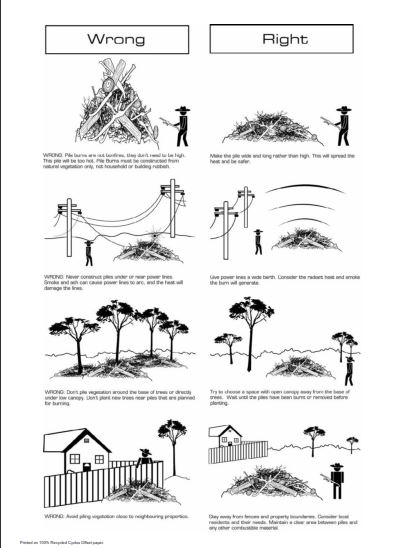
- Material that is to be burnt must only be vegetation from the locality, not household or building material such as plastics, wooden pallets or cardboard boxes (please note it is illegal to burn treated timbers or tyres any where in NSW)
- Construct long and wide piles rather than excessively high piles. Piles that are too high produce more intense heat and retain heat for longer
- Piles should not be greater than 2m in length or width, and must not be greater than 1.5m high
- Logs over 150mm in diameter should not be added to piles - instead they should be laid on the ground to prevent erosion and provide habitat
- If practical, place vegetation in an area where it will receive direct sunlight to allow the pile to dry out
- The fire must be 20m from the nearest building
- All material must be dead and dry before being burnt
-
No soft green weeds (such as wandering Jew, grasses, chick weed) should be
added to a pile burn. These are most effectively disposed of by composting.
Woody weeds such as lantana and privet are suitable. All noxious weeds must be treated according to the guidelines in the Noxious Weeds Act 2003
LIGHTING THE PILE
- The local fire danger rating must be checked prior to lighting the fire, and the fire must not be lit if the bush fire danger rating is at 'very high' or above (unless authorised in a fire safety permit);
- Before lighting the pile, ensure that you have suitable tools handy (rakes and shovels) to conduct the burn and control any possible spot fires;
- Ensure that there is sufficient water to extinguish the burn;
- Ensure that you wear protective clothing such as heavy cotton pants, a long sleeve shirt, leather work boots, work gloves and a wide-brimmed hat;
- Accelerants (such as petrol) must never be used in the pile;
- Disturb the pile immediately prior to lighting to scare away animals such as lizards and snakes which may be taking refuge in the pile;
- Supervise the burn constantly after lighting to ensure there are no flare ups in surrounding vegetation;
- Completely extinguish the pile immediately after the burn is finished. The spreading of burnt material after the burn also assists in allowing for smouldering material to be extinguished.
If multiple piles are to be burnt, burn only one pile at a time unless adequate resources and operators are present at each pile. You should also give consideration to the amount of smoke being produced if multiple piles are being burnt.
BUSH FIRE HAZARD REDUCTION BURNING
Hazard reduction burning is usually undertaken by the RFS. Please contact us for advice or assistance with hazard reduction burning.
To undertake a hazard reduction burn, an environmental approval (Bush Fire Hazard Reduction Certificate (HRC)) is required from your local RFS office. There is no charge for a HRC. HRCs can also be issued for slashing of vegetation for bush fire hazard reduction purposes.
Application form for a hazard reduction certificate pdf
Other Approval For Burning Native Vegetation
Burning standing native vegetation is considered 'clearing' under the Native Vegetation Act 2003 and your CMA will need to determine whether your burn triggers the need for an approval. They will consider the potential impact of your proposed burn or mechanical clearing activity on native vegetation, biodiversity, waterways or important cultural heritage sites.
Contact your local Catchment Management Authority (CMA) for advice on whether you need an approval for burning native vegetation and how to obtain an approval.
